


Minnesota Fraud: Walz Admin Accused of Silencing Fraud Whistleblower

In the midst of one of the largest alleged fraud schemes in U.S. history—potentially involving billions of dollars stolen from Minnesota's taxpayer-funded social services programs—a troubling secondary scandal has erupted: serious accusations that whistleblowers who attempted to expose the fraud were met with intimidation, monitoring, and even threats against their families.
These claims target Governor Tim Walz's administration and the Minnesota Department of Human Services (DHS), suggesting a deliberate effort to suppress internal warnings. As federal investigations intensify and congressional hearings loom, the retaliation allegations have become a focal point, raising questions about whether fear of reprisal allowed the fraud to spiral out of control.
The broader scandal involves "industrial-scale" fraud in programs like child care assistance, autism therapy, Medicaid waivers, housing stabilization, and the infamous Feeding Our Future nutrition scheme. Proven losses already exceed $250 million in some cases, with federal prosecutors estimating up to $9 billion or more across high-risk services since 2018. A viral video exposé in late 2025 showing "ghost" daycares billing millions while empty prompted immediate federal raids, funding freezes, and renewed scrutiny.
The Anonymous Whistleblowers Speak Out
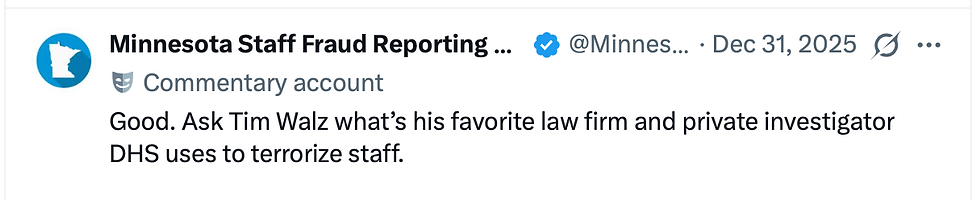
The most direct and explosive accusations come from the X account @Minnesota_DHS, which has operated since 2022 and claims to represent more than 480 current DHS employees. In a series of viral posts from late 2025, the account alleged:
Systematic retaliation including monitoring, threats, repression, reassignments, sidelining, and discrediting of reports.

Leadership under Walz "willfully disregarded rules and laws to keep fraud reports quiet – even to the extent of threatening families of whistleblowers."

Use of private investigators and law firms to intimidate staff.

A culture where fraud was ignored to avoid accusations of discrimination against certain communities (many schemes involve Somali-linked providers).

State Republican lawmakers, such as Rep. Kristin Robbins (chair of the Minnesota House Fraud Prevention Committee), have amplified these concerns. Robbins reports receiving 700–800+ anonymous tips through her whistleblower portal, with many insiders describing themselves as "terrified" of retaliation for prior internal reports. She routes tips directly to the FBI and U.S. Attorney, refusing to share with DHS due to distrust.
An earlier example often cited is Scott Stillman, a former DHS fraud investigator who in 2018 flagged over $100 million in child care fraud (with alleged overseas ties). He claims evidence was suppressed, his work undermined, and he was effectively pushed out—setting a pattern, critics say, for later inaction.
Congressional Scrutiny and Upcoming Hearings
The U.S. House Oversight Committee, chaired by Rep. James Comer (R-KY), launched and expanded its probe in December 2025, explicitly investigating retaliation alongside the fraud. Committee letters accuse the Walz administration of data deletion, record withholding, evidence destruction, and failing to act "for fear of political retaliation."
Hearings are scheduled: The first on January 7, 2026, features Minnesota Republican lawmakers; Gov. Walz and Attorney General Keith Ellison are invited to testify at the second on February 10, 2026.
The Administration's Defense
Governor Tim Walz and the Minnesota Department of Human Services have strongly and consistently rejected any suggestion of systematic retaliation against whistleblowers. DHS officials emphasize that both state and federal law provide robust protections for employees who report wrongdoing, and retaliation is explicitly prohibited. They point to established internal channels for fraud reporting and insist that legitimate concerns are investigated promptly.
The administration highlights concrete actions taken to combat fraud over the years, including appointing a dedicated fraud integrity director, commissioning independent audits, cooperating with federal investigations, and supporting dozens of prosecutions. Walz has publicly taken "responsibility" for strengthening oversight and fixing vulnerabilities, framing recent federal actions—like the HHS funding freeze—as validation of ongoing state efforts rather than evidence of past failure. Officials note that many of the programs in question were expanded or modified under previous administrations, and that Minnesota has recovered millions while referring cases for criminal charges.
Walz and his team have also characterized many of the accusations as deeply politicized attacks, particularly from Republican lawmakers and anonymous online sources during a heated election cycle. They argue that critics are selectively withholding tips (via private portals) that could help stop fraud faster, and that some claims lack verifiable evidence or come from unrepresentative voices. DHS maintains that no credible complaints of retaliation have been substantiated through official channels, and they have invited transparency by welcoming federal oversight and audits to clear the record.
In public statements, Walz has stressed a commitment to accountability and transparency, saying the state will continue working with law enforcement to root out fraud while protecting employees who come forward in good faith. The administration views the upcoming congressional hearings as an opportunity to present facts and counter what they describe as misleading narratives.
Why This Matters
If substantiated, these allegations could reveal a chilling effect that enabled massive taxpayer losses. With the Trump administration's HHS freezing funds and federal agents raiding sites, the scandal is already high-stakes. Upcoming hearings may force testimony and documents that either validate or debunk the claims—potentially with profound political consequences for Walz and trust in state oversight.
Taxpayers, meanwhile, await accountability. As one anonymous post warned: "It’s actually quite stressful to tweet because we anticipate and expect retaliation. It’s the Tim Walz way."


Comments